The Informer: End of Imperial Calcasieu came at close of 1912
Published 4:58 am Sunday, February 22, 2026
Three parishes were carved from Imperial Calcasieu on Jan. 1, 1913, and became Allen, Beauregard and Jeff Davis parishes.
That was the second division of what the Lake Charles American Press described as “the great parochial domain of the state” in its Dec. 31, 1912, edition. The first was when Cameron was sliced off in 1870.
“Calcasieu has long remained the imperial parish in size, and has stood to the forefront in other respects during many years. In area, Calcasieu is larger than the states of Rhode Island and Delaware put together; as large as some of the principalities of Europe, and rich in resources beyond compare,” the article reads.
At the time, Calcasieu was second to New Orleans in terms of population and “harbored the largest sulphur mine in the world; its timber industry ranked among the first of the country; and it was undeniably the rice center of the United States.”
Calcasieu became a parish in 1851.
“Previous to that time from the foundation of the state in 1812 this territory was embraced in St. Landry Parish, which at its origin comprised most of the land west of the Teche and south of the Red River,” the article reads. “Calcasieu was created out of St. Landry, containing the present area along with a good part of Vernon and all of Cameron parishes.”
The newspaper said during the reconstruction period after the Civil War, Vernon and Cameron parishes were created. When Calcasieu was split into four slices, the portion left of Calcasieu was an area about 1,000 square miles.
“Still one of the largest parishes of the state, easily one of the richest,” the newspaper declared. “The other parishes, too, are of good size, well peopled and rich.”
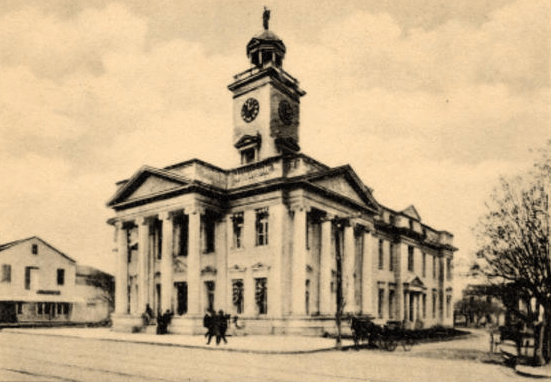
At the time of Imperial Calcasieu’s split, it was on its fourth courthouse.
“The first, erected at the beginning of the parish, stood a while at Marion on Old Town Bay — the Texas trail over which went most of the travel and traffic of those days, passed through the country about the present size of Lake Charles, crossing the Calcasieu at Hartman ferry. Samuel Kirby and Jacob Ryan concluded to have the parish seat located here, so the former donated the site now owned by the parish and upon which the magnificent new court house stands.”
But before that happened, Ryan got together the ox teams necessary and had the frame of the log-house courthouse moved down from Old Town Bay. That courthouse served the area until 1870 when another wooden building supplanted it.
“This lasted until the latter 1880s when a brick building was put up,” the newspaper reads. “In 1900 this building was added to by the erection of additional rooms, together with alterations. The building did service until its destruction by fire April 23, 1910, being replaced by the brick and terracotta structure completed a few months ago at a cost of $200,000.”