The Land of Fairytales: Experience an otherworldly landscape in central Turkey
Published 8:16 am Sunday, February 15, 2026


By Mary Richardson | Special to the American Press
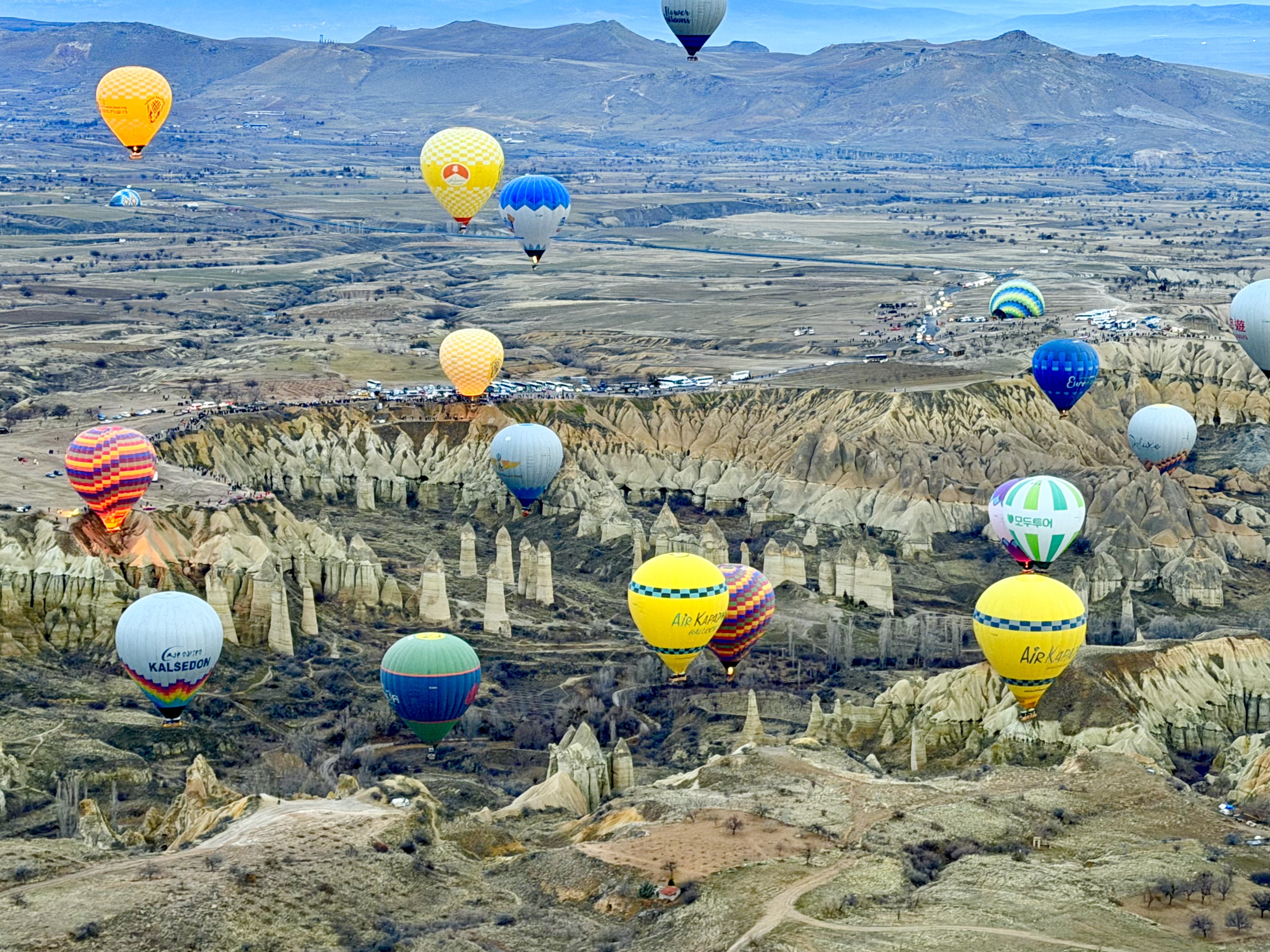
We were high in the sky, riding in a hot-air balloon in the Cappadocia region of Turkey. All was quiet, except for the loud woosh when the balloon’s burner ignited. It was bitterly cold in the early, pre-dawn hours, so we appreciated those bursts of fire; they brought momentary warmth. Then the sun rose over the valley, turning the bare rocks golden. Everything we had walked through and touched in the previous days was laid out before our eyes. It is this landscape, like no other in the world, that defines Cappadocia.
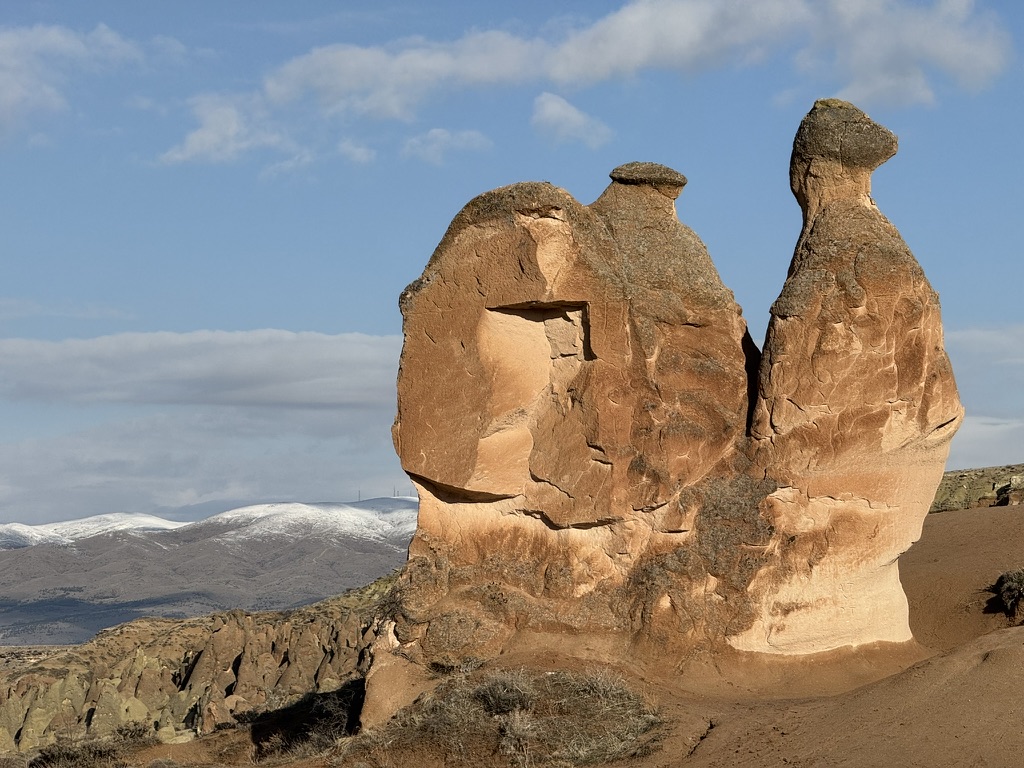
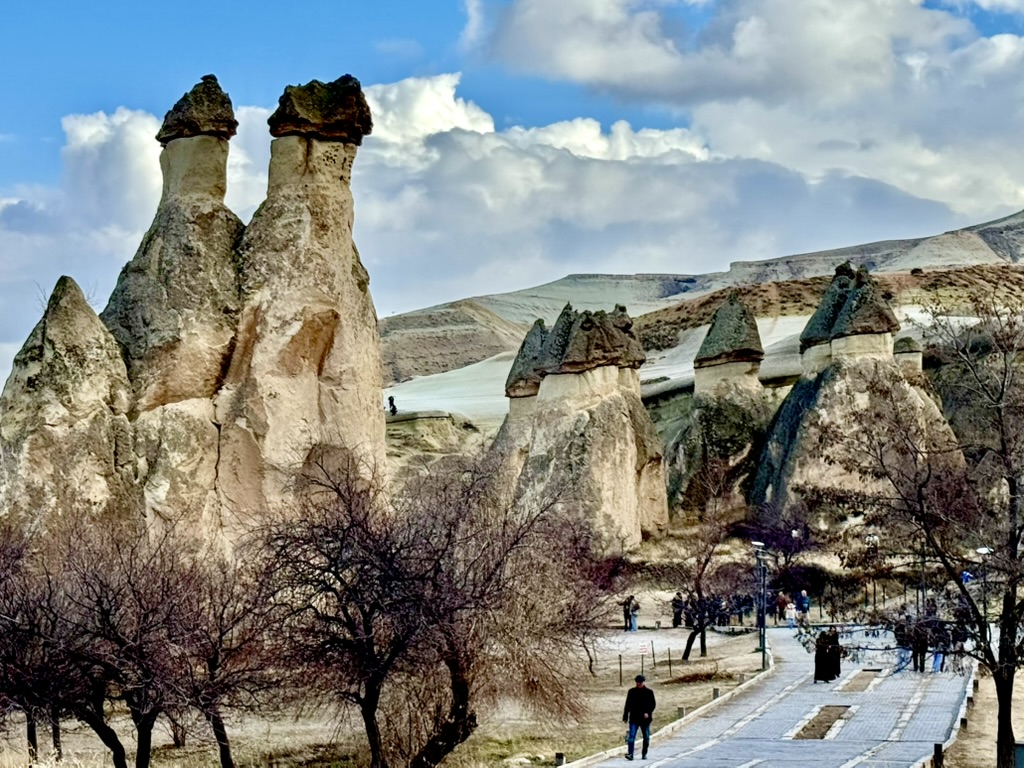
This bird’s-eye view was a gift of clarity. Up in the air, I could see how the many aspects of Cappadocia that my husband, Joe, and I had been exploring all fit together. There were the wild, ungainly, geographical formations called “fairy chimneys” that looked as if they would be at home on the moon. We could see the caves that illustrated the history of mankind in this bizarre landscape. The brown cliffs were pockmarked with caves that had been inhabited by people before the time of Christ. More caves that had been dug into rock, cone-like formations rose from the valley floor. “Where are the Smurfs?,” Joe asked, “There ought to be Smurfs.” He was right. Those small, blue creatures who lived in the mushroom-shaped houses depicted in the Smurf cartoons would have been right at home.
What we couldn’t see from the air were the underground caves that had protected Christians from the Romans. Also hidden from us were the churches carved into living rocks that had been used for more than a thousand years, gradually falling into disuse. But we knew they were there.
Cappadocia is not a single town. Instead, it is a broad region in central Turkey with roots in antiquity. When the weather was clear, we could see a snow-capped volcano, part of a ring of volcanoes that had shaped the region. Their eruptions created a rock called “tuff,” which can be carved with simple tools, and people had been digging homes and churches into this tuff for the past millennia. Their handiwork dates from many periods of history — Persian, Hellenistic, Roman and Byzantine.
We had seen the underground caves at Güzelyurt. These caves, dug specifically for human habitation, predate Christianity and even classical antiquity. However, they became vitally important during the first three centuries of Roman rule after the birth of Christ, when Christians hid in them to escape persecution. Then came Emperor Constantine, who decided the Roman Empire should be Christian. By signing the Edict of Milan in 313 AD, he granted religious toleration. Not only did the edict end the persecution, it also allowed Christians to own property. They built houses above ground, and the underground caves were relegated to the storage of food and animals
We had descended through a narrow tunnel, moving from one low-ceilinged, soot-darkened room to another. I soon felt lost, as if I were inside a puzzle. Then we got to a lovely room, lit with gentle light from a ventilation shaft. It was the winery. I could see myself hopping into what looked like a big stone bathtub and stomping grapes harvested from the fields above.
Then we entered another, larger room. This was a room for animals, and feeding troughs had been carved directly into the walls. I imagined close quarters with woolly sheep, noisy chickens, and animal excrement — and was very happy to squeeze into another tunnel that led to the surface. Still, the overriding impression was of domesticity. I could see people living there in times of need. Even with the sheep and the chickens.
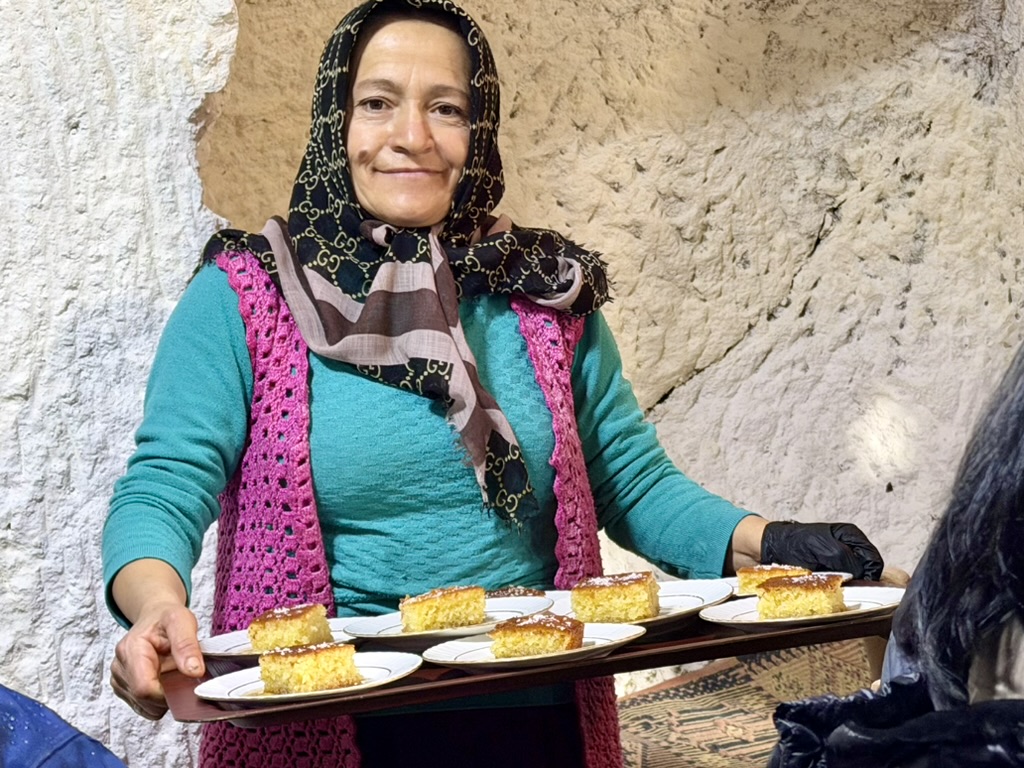
The village of Güzelyurt was very different. The homes were not exactly caves. Indeed, the facades of the buildings and houses facing the street looked “normal.” However, behind the façades, the living quarters had been carved into living rock. Our travel group, Gate1, had arranged for us to have a Turkish lunch prepared by a family who lived in one of these houses. We could touch the whitewashed tuff walls as we descended to a large dining room to share a vegetarian meal. The room was filled with goodwill, delicious smells, and a sense of camaraderie as we devoured lentils, chickpeas and fresh pita bread. There was no sense of a troubled history.
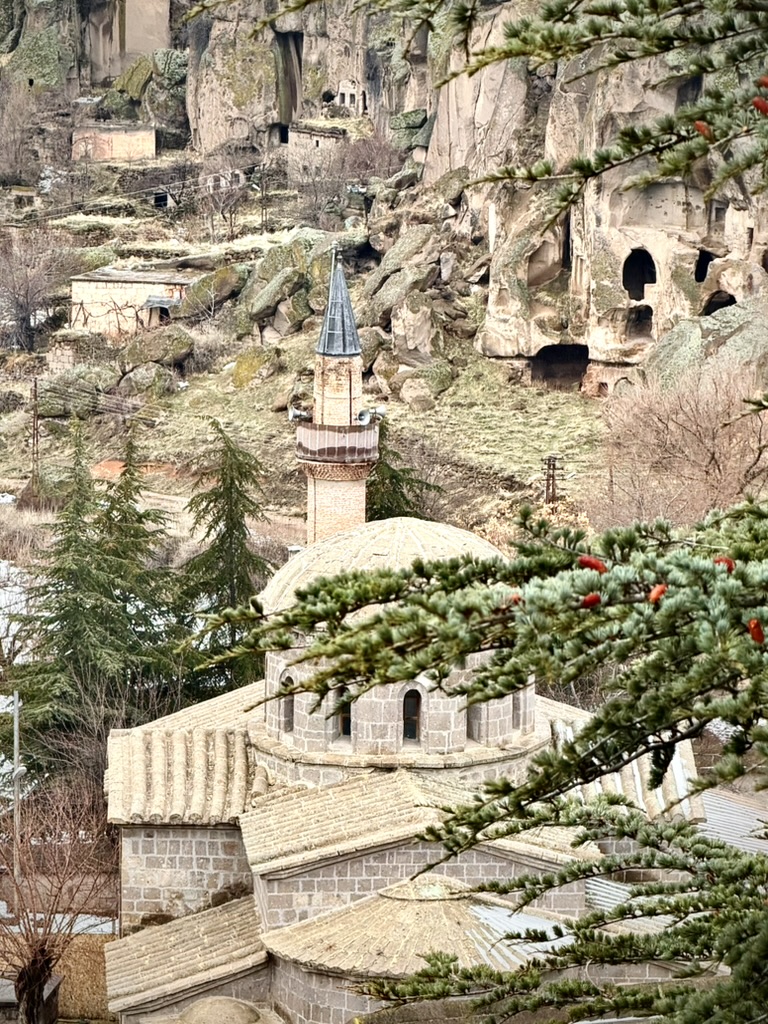
That history became apparent as we walked down the path from the house, leading us to a gorgeous view into the valley. There were the ancient caves carved into the cliffs – and, right below them, a mosque. It was the Büyük Kilise Camii (Great Church Mosque), originally built in 385 AD as the Christian Church of St. Gregory of Nazianzus. Its change from church to mosque encapsulated the turmoil of a “population exchange” that took place in 1924. It transformed Güzelyurt from Christian to Muslim. This happened after Kemal Atatürk came to power in 1922 and made several reforms that reverberate today (e.g., changing the Persian-Arabic script to the Western alphabet, changing the day of worship from Friday to Sunday, and forbidding women to wear head scarves). It also resulted in Greece declaring war on Turkey, a war the Greeks lost. The subsequent 1923 Treaty of Lausanne called for a broad compulsory population exchange. Güzelyurt had been a major center for Cappadocian Greeks, but in 1924, its entire Christian population was forced to leave for Greece. Muslim Turks then moved into Güzelyurt, and in many cases, right into the homes the Christian Greeks had been forced to abandon. But we didn’t sense any of that as we enjoyed honey-infused Turkish cake and strong Turkish tea. We didn’t know.
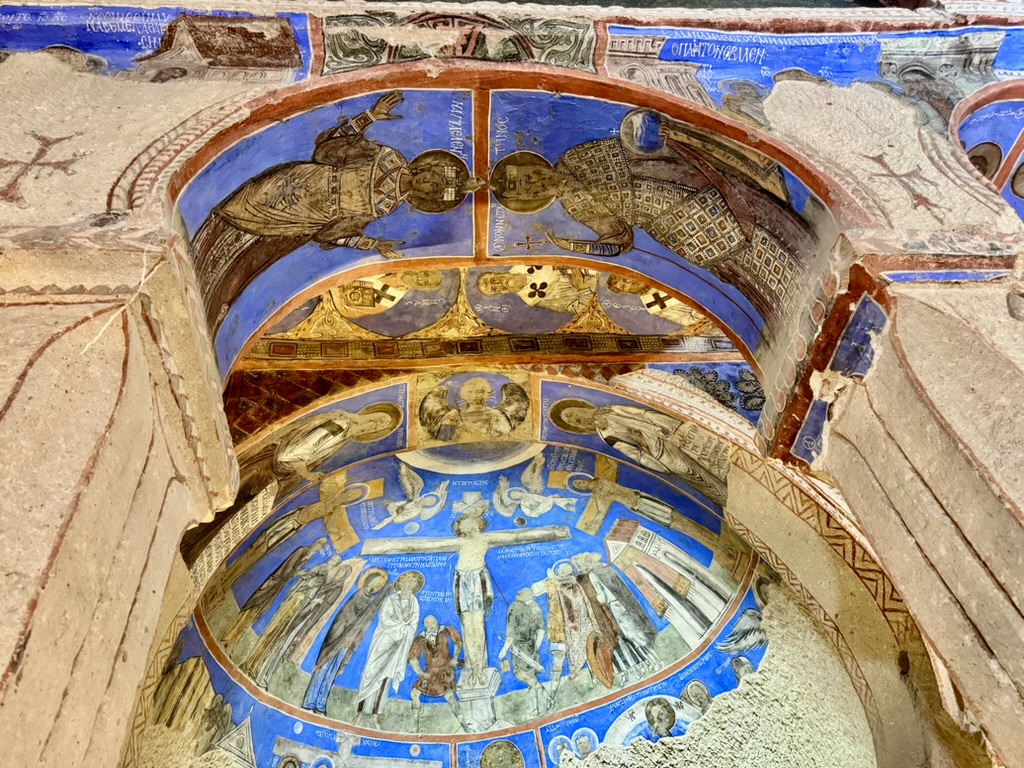
Quite a different story emerged when we visited the early Christian churches carved into the cliffs at the Göreme Open-Air Museum. This place, not established as a tourist site until the 1960s, evoked feelings of ancient Christian worship. It felt holy. We joined other people climbing narrow paths, so close to the fairy chimneys that we could touch them. These fairy chimneys are found nowhere else on earth (although the hoodoos in places such as Bryce Canyon National Park in Utah come close). The paths led us to churches carved deep into the cliffs. People were generally silent as they entered, and I thought I could feel the piety of these early Christians. Frescoes, many fading but others undergoing restoration, depicted the full narrative of the life of Jesus. There were saints, apostles, and martyrs. Even faded, it wasn’t hard to imagine the original deep red, ochre, and indigo blue colors. The earliest, simplest frescoes had been painted about 580 AD, but the more elaborate ones dated as late as 1200 AD. One of the latter, the Byzantine “Christ Pantocrator,” had been painted in the apex of a dome. A bust-length, stern-faced Christ, holding the New Testament and surrounded by angels and prophets, was making a blessing gesture as he looked down at us in his rock church.
So why hadn’t these churches been turned into mosques? Why had the faces in the frescoes not been defaced? The answers seem to be because the site was remote, neglected and considered unimportant. The churches weren’t conquered: they just fell out of use. Also, these dim, rock-cut cave churches weren’t suitable for mosques, which require clear light, open prayer spaces, and an orientation toward Mecca, so they were just left alone.
This indifference finally changed when European and Turkish scholars began documenting Byzantine frescoes, and art historians discovered that Cappadocia held a treasure trove. They realized his site was much more than a regional heritage; it was globally significant. In 1985, the area became a UNESCO World Heritage site, and today, tourist buses arrive.
Our adventure in Cappadocia came to an end with the balloon ride. I looked down at the moonscape below, at the tuff cliffs pocked with caves, at the fairy chimneys rising like rockets from the brown ground. I tried to imagine the wars of ages, when the Christians hid in caves from the Romans, when the Greeks and the Turks tried their best to kill each other and claim this land. But I couldn’t see it. In the cold, early morning light, it just looked peaceful. Cappadocia felt lovely, and I was just grateful to have walked on its paths.
•
Editor’s note: Joe and Mary Richardson were part of a tour by Gate1 Travel, “13-Day Affordable Turkey,” arranged by travel agent Anne Rose, this past January.